Damaged
or more interesting?
Sometimes we stop wearing a piece before we stop loving it.
The jumper we reached for when nothing else felt right. The shirt that survived several versions of our style. The jeans that, of all the pairs we have owned, are still the pair.
We still love the piece.
Then comes a hole. Or a stain that refuses to budge. Or wear that changes how the garment looks. We do not want to lose it, but we do not quite want to wear it as it is. So it spends months in the very unhelpful ‘I'll deal with it’ pile.
In a small qualitative study, five people described garments they still wore and the memories and personal meanings attached to them. That does not mean everyone feels this way about clothes. It does help explain why replacing that particular piece with a similar one may not solve the problem. Read the study
What do we want to keep?
Perhaps the jumper works precisely because it is plain and grey. A discreet darn lets it stay that way. But after all this time, perhaps we would rather give it something new.
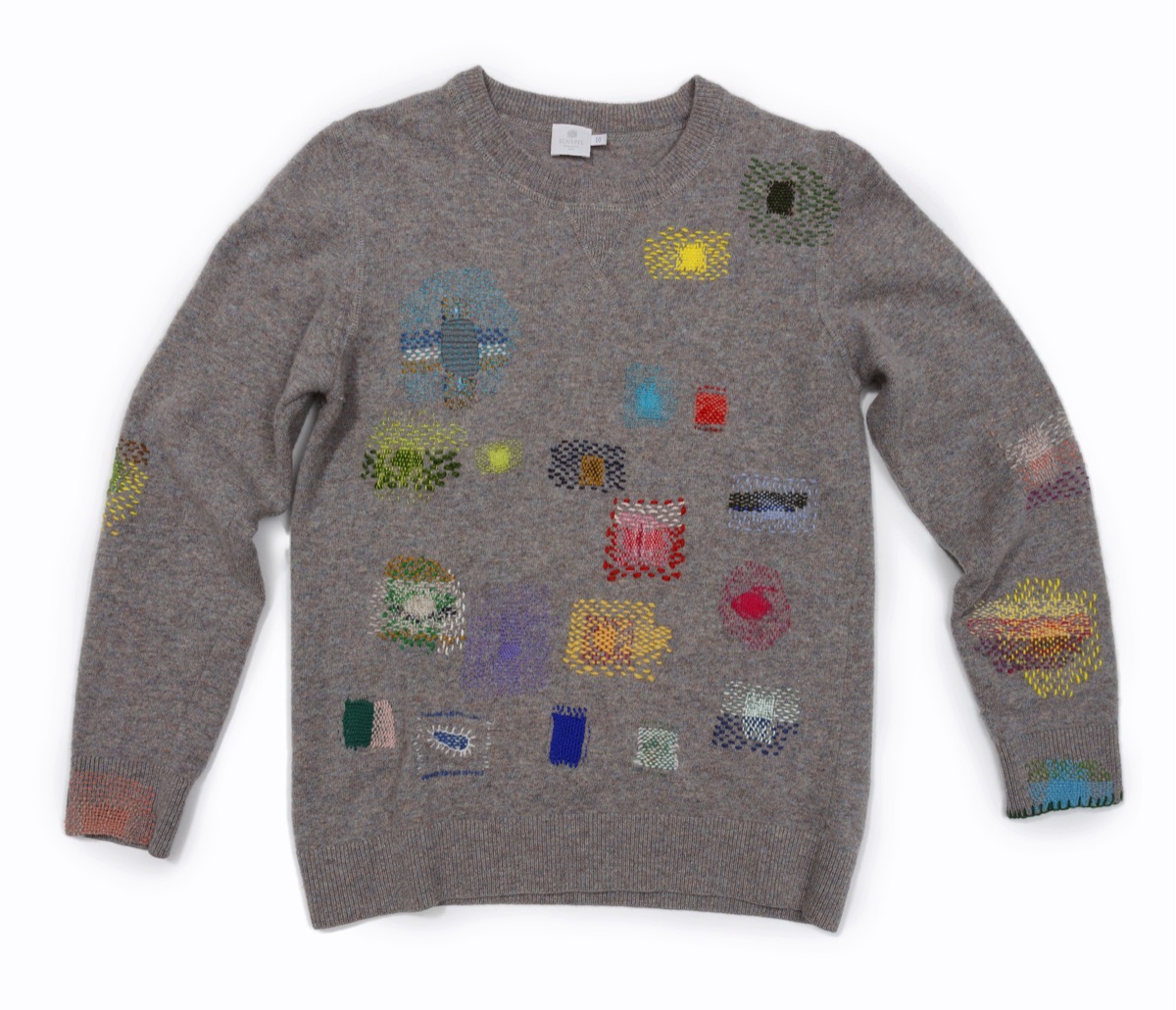
Celia Pym's Teaching Jumper began as a grey sweater with a single moth hole. The repair makes us look again. This is not a request to turn every hole into art. It is a reminder that mending does not have to return a garment to its original appearance. View the work
Researchers following mending practices in workshops in Estonia observed that repairs could add meaning and change how a garment was appreciated aesthetically. This was qualitative work in one particular setting, not a promise that we will like every visible mend. Read the research
The mark is only the beginning.
Matching thread keeps the garment quiet. A contrasting colour makes the repair the detail you notice.
Before embroidering or dyeing, look at the fabric, size and position. Not every stain has an elegant fix.
A reinforcement has to support the fabric, not just look good in a photograph. If the surrounding cloth is weak, ask a repair specialist.
Would you wear its next version?
In a survey of 161 young fashion consumers in South Korea, willingness to repair was linked to garments that mattered to their sense of style. It does not tell us to save every damaged item. It suggests that wanting to wear it again matters. Read the study
Sometimes the answer is no. A garment can reach the end of its useful life. But when we still care about it, a sign of wear need not have the final word.